
Firewood Calculator
Firewood is sold in cords, face cords, ricks and loads — and sellers don’t always mean the same thing. Measure the stack you are buying (or have), and the calculator converts it to full cords, face cords and cubic metres, works out the real price per cord, estimates how much heat that wood holds by species, and compares the cost of that heat with oil, propane, natural gas and electricity.
- Free to use
- No sign-up
- Runs in your browser
Firewood calculator
Firewood Planner Templates
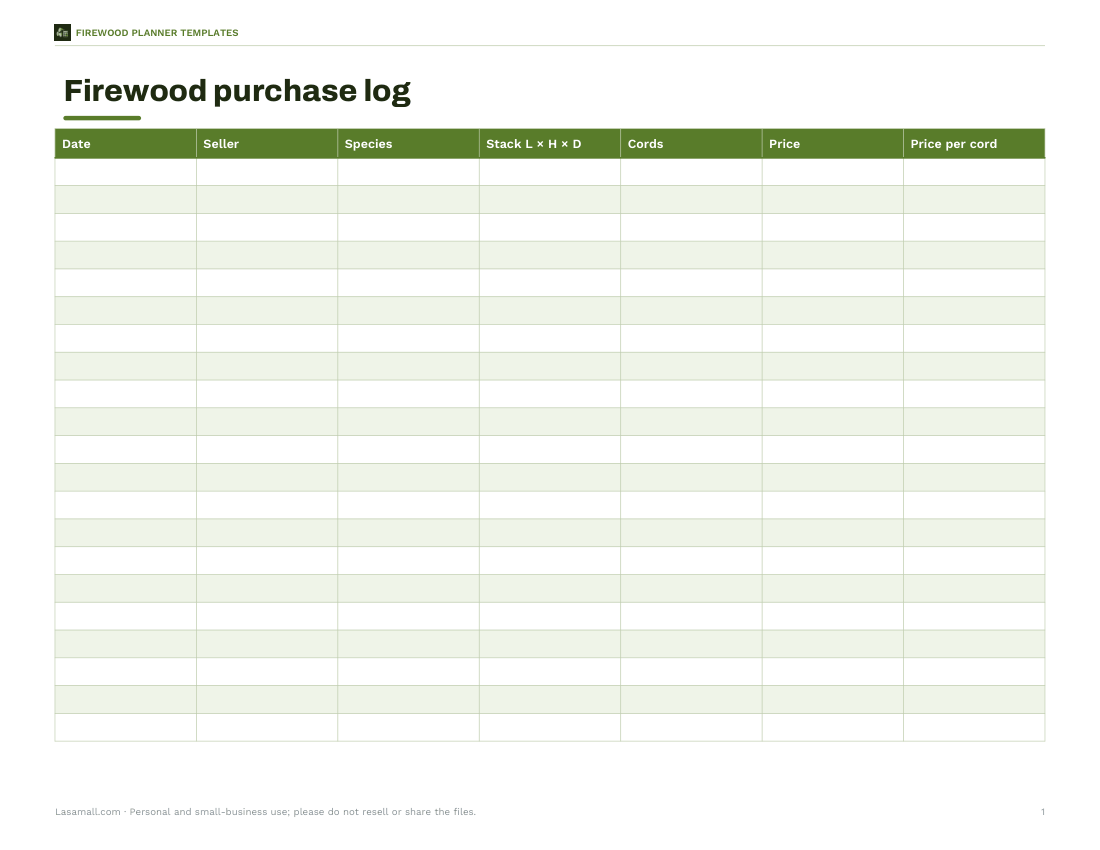
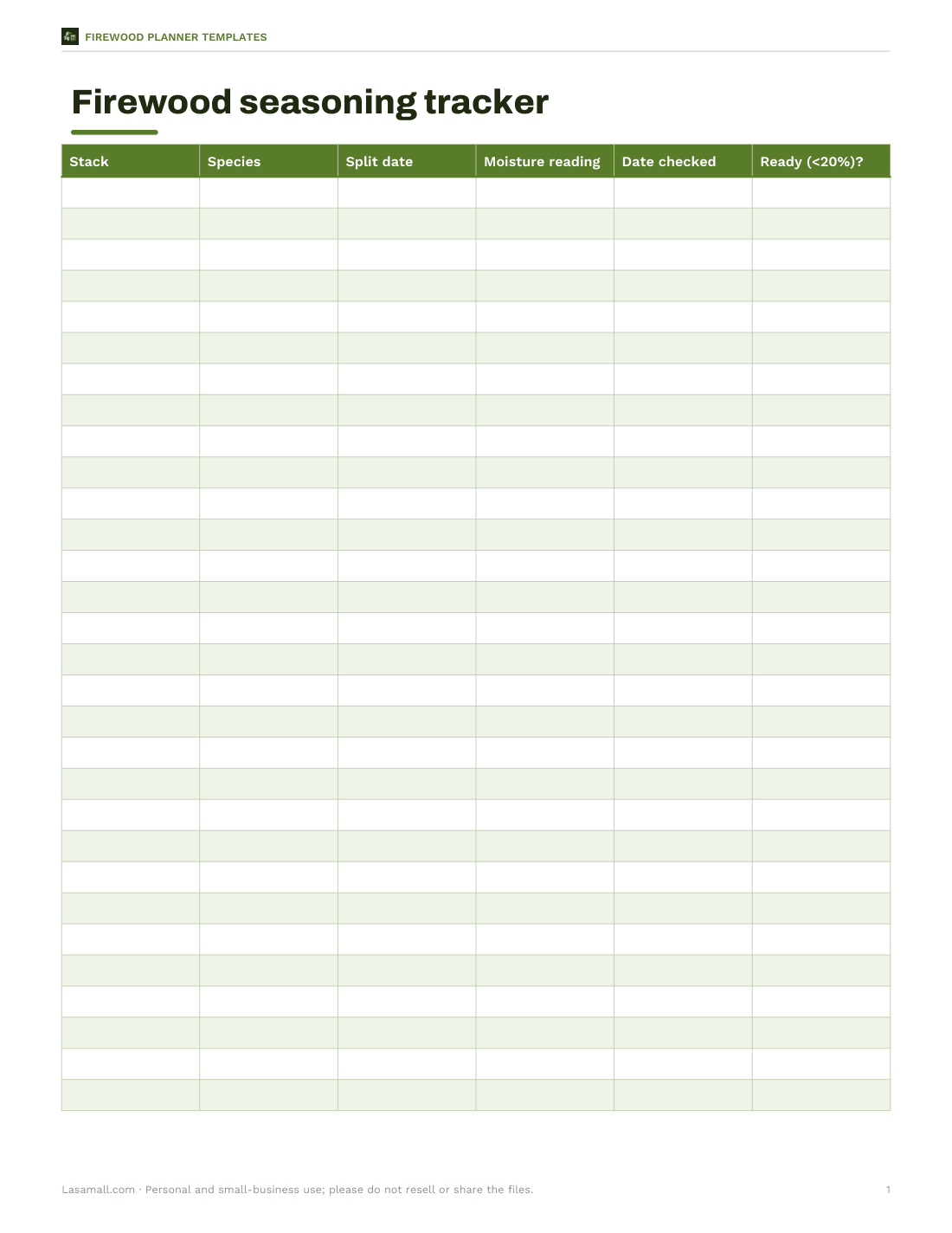
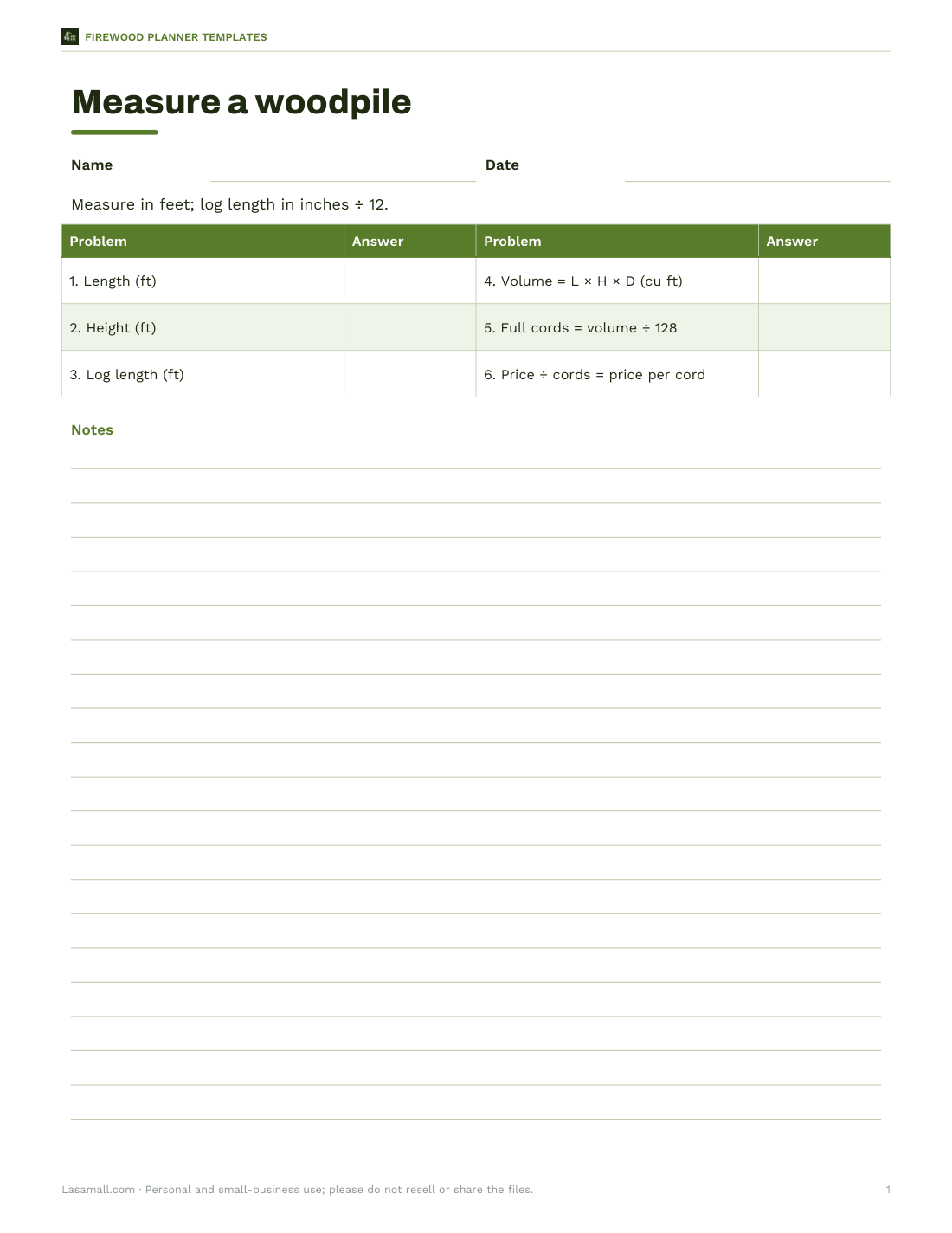
Firewood purchase log, seasoning tracker with moisture readings, stack measurement worksheet, an Excel heating fuel comparison and a chimney maintenance checklist.
- Purchase log (XLSX)
- Seasoning tracker (PDF, XLSX)
- Measurement worksheet (PDF, DOCX)
- Fuel comparison (XLSX)
- Chimney checklist (PDF, DOCX)
Formats: XLSX, PDF, DOCX. Instant download after payment (link valid 72 hours, up to 5 downloads). AI-assisted: the templates were drafted with AI help and reviewed and laid out before publishing.
$5.00 USD, one-time 5 files · about $1.00 each
- Instant download
- 7-day refund
- Secure checkout by Stripe
7-day money-back guarantee. Full refund within 7 days of purchase, even after you download.
Free sample: Firewood Purchase Log (PDF, 54 KB)
Full refund within 7 days — see the refund policy and license.
Free printables
Single sheets you can print right now, no sign-up. The full pack adds every sheet in one download plus the editable files.
 Printable Firewood Purchase Log
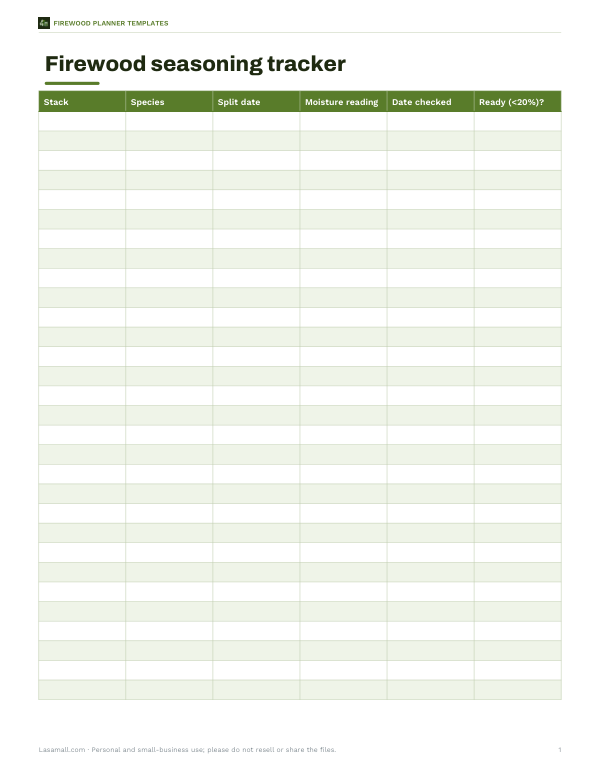 Printable Firewood Seasoning Tracker
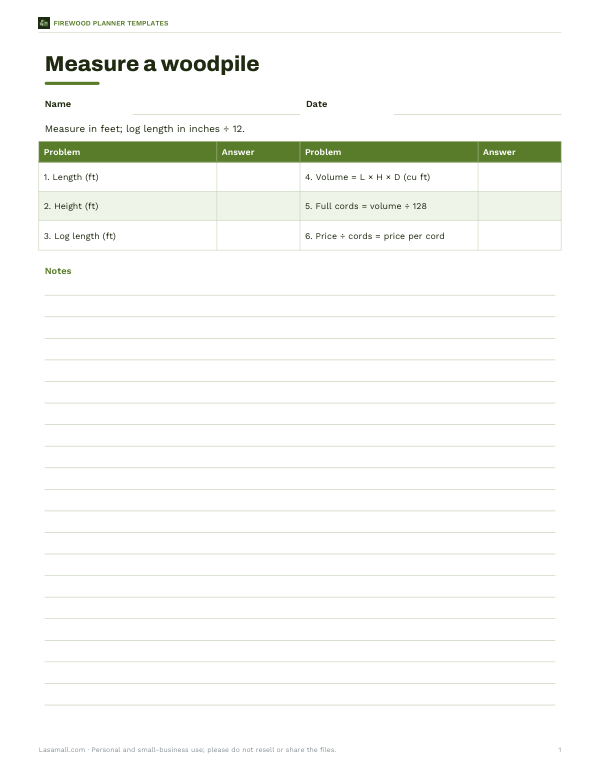 Printable Firewood Measurement Worksheet
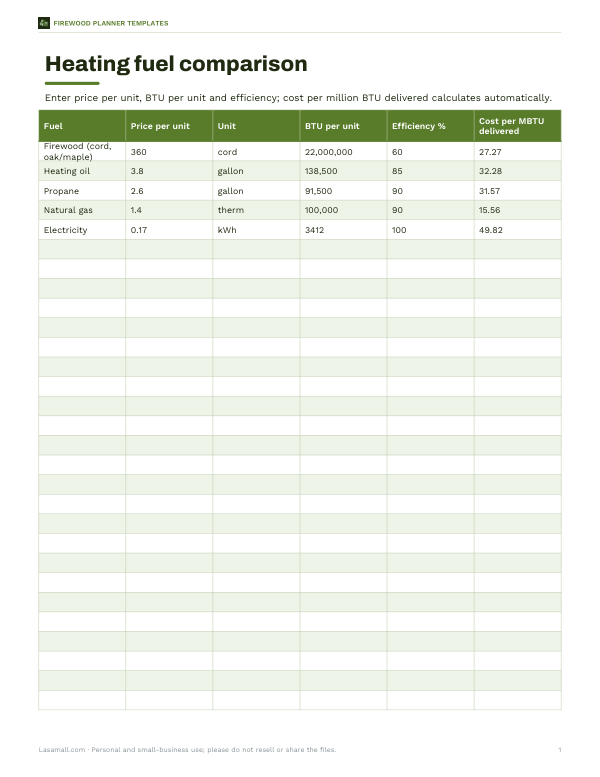 Printable Fuel Comparison Sheet
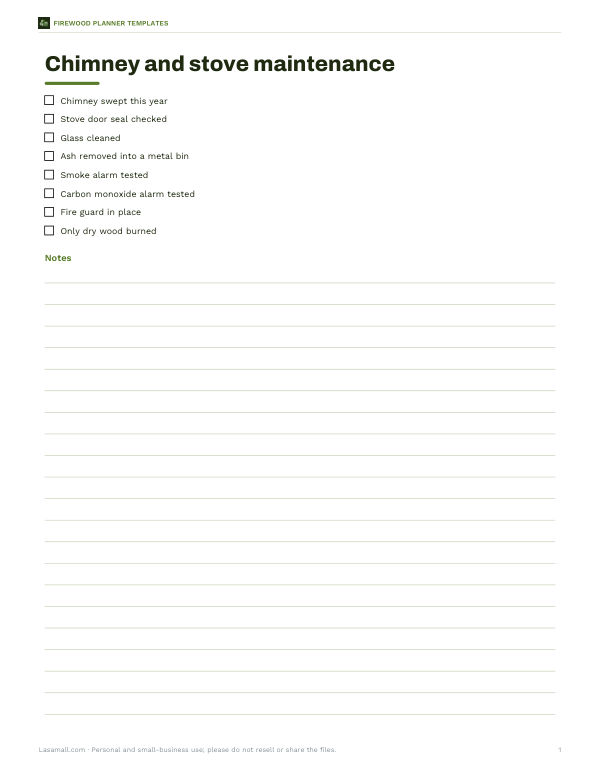 Printable Chimney Checklist
Cords, face cords and ricks
| Unit | Size | Volume |
|---|---|---|
| Full cord | 4 ft high × 8 ft long × 4 ft deep | 128 cu ft (3.62 m³) |
| Face cord / rick | 4 ft high × 8 ft long × one log length deep | With 16-in logs: 42.7 cu ft — one third of a cord |
| Half cord | 4 × 4 × 8 ft stacked, or 4 × 8 × 2 ft | 64 cu ft |
| Pickup load | Depends on the truck and how it is loaded | Often a third to half a cord, loosely thrown |
A cord is a legal measure in the US and Canada for tightly stacked wood. “Face cord”, “rick”, “rank” and “truckload” are not standard, so always ask for the stacked dimensions — or measure yourself, as the calculator does.
How the calculator works
- Volume = length × height × log length (depth), times the number of rows.
- Full cords = volume ÷ 128 cubic feet.
- Face cords = the stack’s face area ÷ 32 square feet (a 4 × 8 ft face), at whatever log length you have.
- Price per cord = what you paid ÷ full cords, so you can compare quotes fairly.
- Heat = cords × typical million BTU per cord for the wood type × your appliance’s efficiency.
- Other fuels are compared using standard heat contents: heating oil 138,500 BTU per gallon, propane 91,500 BTU per gallon, natural gas 100,000 BTU per therm and electricity 3,412 BTU per kWh.
Heat by wood type
| Wood | Heat value | Approx. million BTU per cord | Notes |
|---|---|---|---|
| Hickory, oak (white), black locust, ironwood | High | ~25 | Long-burning, excellent coals; oak needs 1–2 years to season |
| Red oak, sugar maple, beech, ash, apple | High–medium | ~22 | Very good all-round firewood |
| Birch, cherry, elm, red maple, walnut | Medium | ~19 | Good for shoulder seasons; birch lights easily |
| Poplar, aspen, willow, basswood, cottonwood | Low | ~14 | Burns fast; fine for kindling and mild days |
| Pine, spruce, fir, cedar | Low–medium | ~15 | Lights quickly; burn hot and dry to limit creosote |
Heat per cord depends on wood density and dryness; values are rounded typical figures for seasoned wood (about 20% moisture). Dense hardwoods pack more heat into each cord; softwoods have similar heat per pound but less per cord.
Worked example
A seller offers a “face cord” for $120. You measure the stack: 8 ft long, 4 ft high, 16-inch logs — about 42.7 cubic feet, or 0.33 of a full cord. That is $360 per full cord. If it is mixed oak and maple (about 22 million BTU per cord) burned in an older stove at 60% efficiency, it delivers about 4.4 million BTU — around $27 per million BTU. With heating oil at $3.80 a gallon in an 85%-efficient boiler, heat from oil costs about $32 per million BTU, so this firewood is slightly cheaper.
Seasoning: why dry wood matters
Freshly cut wood can be half water. Burning it wastes heat boiling the water off, produces more smoke and creosote in the chimney, and gives far less warmth. Split wood and stack it off the ground, bark side up, with the top covered and the sides open to the wind, and let it dry for 6–12 months (oak often needs longer). A moisture meter reading below about 20% on a freshly split face means it is ready.
Buying firewood
- Ask for the price per full cord and the log length.
- Ask whether it is seasoned and how long it has been drying.
- Measure the stack before paying if you can.
- Buy locally — moving firewood long distances can spread tree pests; many areas restrict it.
- Buy next winter’s wood in spring so it can finish drying.
How much firewood for a winter?
The amount varies hugely with climate, house size, insulation and how much you rely on wood. As a starting point, keep a log of the cords you burn this season in the template pack; next year you can buy the same amount early enough to season it. Households heating mainly with a wood stove in cold climates often use several cords per winter, while occasional fireplace use may need less than one.
Safety
Have chimneys and flues inspected and swept regularly, burn only dry, untreated wood, install smoke and carbon monoxide alarms, and keep a fire guard in front of open fires. Never burn painted, treated or pressure-treated wood, plastics or household rubbish.
The printable firewood templates
The template pack includes a firewood purchase log, a seasoning tracker with moisture readings, a stack measurement worksheet, an Excel heating season fuel comparison and a chimney maintenance checklist — PDF, Word and Excel.
Frequently asked questions
How much is a cord of wood?
128 cubic feet of stacked wood — for example a 4 × 4 × 8 ft stack.
What is a face cord?
A 4 × 8 ft stack one log length deep; with 16-in logs it is one third of a full cord.
How do I calculate cords from a stack?
Multiply length × height × depth in feet and divide by 128.
Which firewood gives the most heat?
Dense hardwoods such as hickory and oak.
Is firewood cheaper than heating oil?
Often, but it depends on local prices and stove efficiency — the calculator compares them.
How long does firewood need to season?
Usually 6–12 months after splitting; oak often longer.
What is a rick of wood?
A regional name for a face cord — a 4 × 8 ft stack one log length deep.
Can I burn wet wood?
It burns poorly and creates more creosote; season it first.